Trenzar
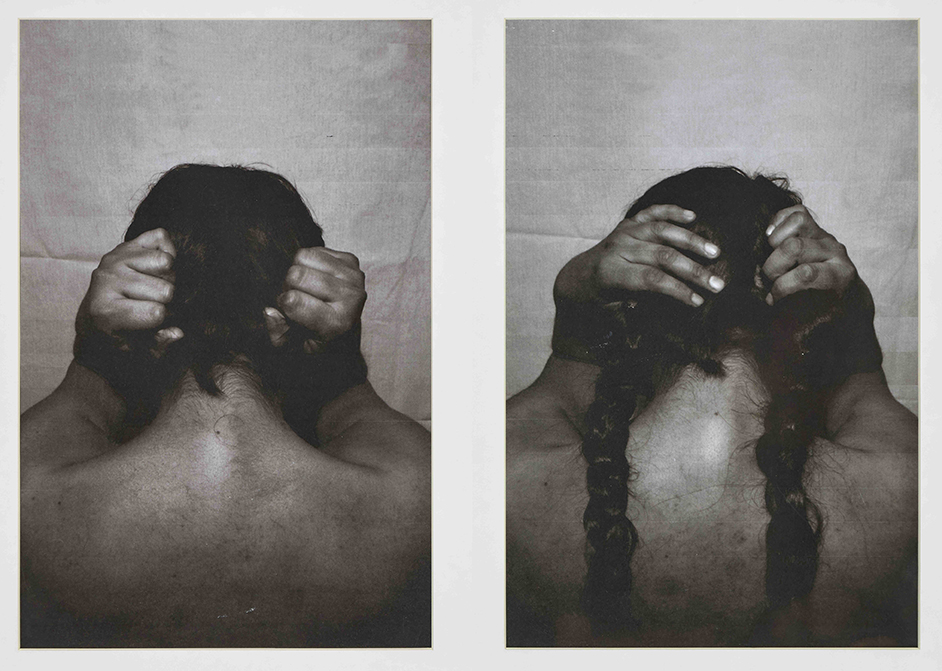
Trenzar—tresser, in French—is an exhibition on identity. A look back to build the future: an Andean and Aymara way of understanding time. The image that opens this exhibition is a photographic diptych: the artist from behind, as she cuts her braids. An intimate and radical gesture, the starting point of a reflection on what we wear, what we lose and what we choose to transmit.
Because we can braid hair, the music of sikuris, memory or even roots. Trenzar is a mapping of the body through the hair—the guiding thread of a work that embroiders what has disappeared. Embroidering is also an act of resistance. Passing on knowledge, learning to embroider in order to live, to heal. In this logic, each piece of the exhibition becomes a territory: textiles, embroidery, human hair, photographs and stones make up a space where body and collective memory meet.
This exhibition follows the retrospective Lengua Materna—20 years of work, recently presented at ICPNA (Instituto Cultural Peruano Norteamericano, Lima) curated by Miguel López, a major figure in Latin-American curatorial thought.contemporary American who describes her work as follows: "She develops a multidisciplinary practice that erases the boundaries between biographical and social, between poetry and document. Her work offers a journey through the management of domestic space, play, education, history, language and the vivid traces of political violence.